I see a lot of comments here criticizing the author, and I think both teams have a point. There's definitely a bubble, because companies are buying up infrastructure which doesn't need to be used right now.
But also, the companies are buying up this infrastructure because whoever controls the infrastructure also controls the industry in around 5 years time.
It's not just Satya, the CEOs of all the hyperscalers are consistent in their messaging over the last several quarters that they are backlogged on capacity. Not only are they saying it, they are putting their money where their mouths are by actively burning double-digit billions of their free cash flow on this buildout.
How probable is it that all these competitors are colluding on the same story while burning what would have otherwise been very healthy profits?
Being the CEO of a notable publicly traded company (and liable if caught lying about what they do with billions of shareholders dollars) surely a little more than random HN commentator without sources...?
And just when was the last time you saw CEO of a company as big as Microsoft "caught lying to shareholders" about anything actually face any punishment?
CEOs of big public companies lie to their shareholders all the time. It would be fantastic if they could be held accountable for those lies, but AFAIK when the SEC has tried, they always weasel out of it by saying things like "well, from what I knew at the time, it was true" or "if you interpret it this (ridiculous) way it was true". It's very, very hard to prove malicious intent—that is, prove what was going on in the CEO's head when they said it—with something like this beyond doubt, and that's effectively what's required.
> And just when was the last time you saw CEO of a company as big as Microsoft "caught lying to shareholders" about anything actually face any punishment?
Actually curious, when was the last time we saw a CEO of a company as big as Microsoft caught lying to shareholders?
The one instance I can recall offhand of big companies doing fraud were cases like Enron, which resulted in execs going to jail. More recent cases of CEOs were not large companies and they also ended up with them in prison, e.g. Nikola. (Sure the guy's out again, but that's been done, uh, outside the usual process of justice.)
That part of the article is about US cases, so its US law that applies.
> A GPL license is a contract in most other countries. Just not US probably.
Not just the US. It may vary with version of the GPL too. Wikipedia claims its a civil law vs common law country difference - not sure the citation shows that though.
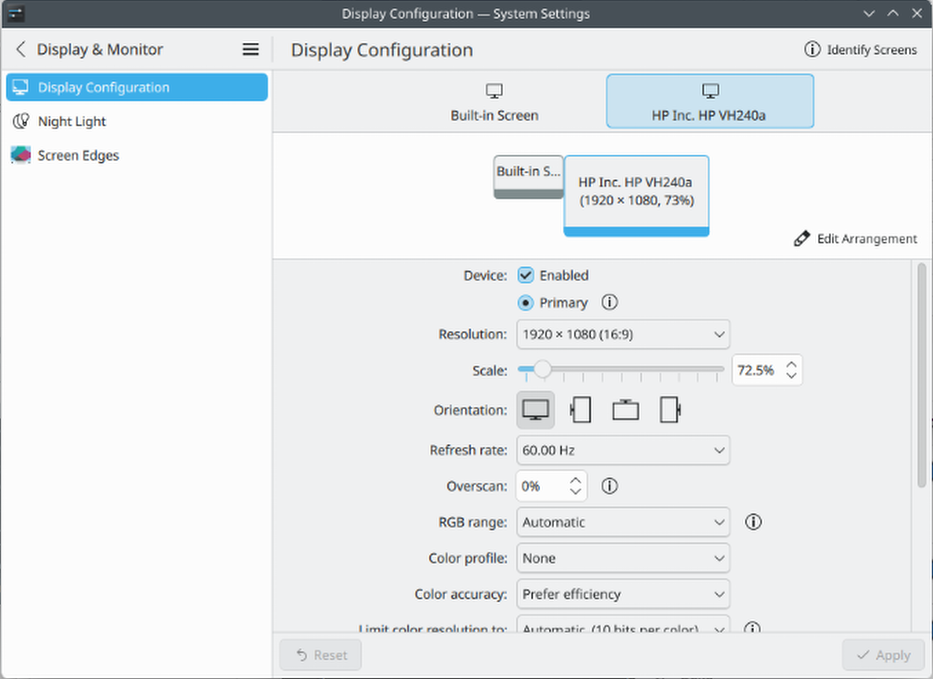
On KDE you can just type a number into the scale percentage field in the display configuration settings pane. I typed "73" and it snapped to 72.5 which is probably close enough.
I don't know whether GNOME supports anything similar, unlike KDE they really don't like giving users very many configuration options.
Weird, mine lets me go down to 50%: https://files.catbox.moe/gjuzl6.png . Out of curiosity, do you use an nVidia graphics card? I know in the past their drivers have had problems with scaling on Linux.
It is yes! It's great. What I like about FreeBSD is the decoupling of packages and OS. You can have a stable OS version but still have rolling packages. Somehow most Linux distros can't manage that.
I also like that I don't constantly have to learn new stuff like the new ip commands or systemd. It just works. Oh and ZFS on root as a first class citizen is amazing of course.
> What I like about FreeBSD is the decoupling of packages and OS. You can have a stable OS version but still have rolling packages. Somehow most Linux distros can't manage that.
This! I didn't realize how much I wanted this. FreeBSD release base packages are stable but all the regular packages are super up to date. Plasma looks very updated and stable.
I've tried rolling distros like Opensuse Tumble and Manjaro but eventually if you don't update them regularly you get a huge change and often many things change/break. Had your bluetooth speakers working finally? Now that's gone!
On the other hand stable releases in linux distros also seem to fail. Didn't update your random Ubuntu server in the corner of the office for the last year? Well now the apt links are broken and down for the release so you can't update the current release so you can upgrade.
> I also like that I don't constantly have to learn new stuff like the new ip commands or systemd. It just works. Oh and ZFS on root as a first class citizen is amazing of course.
It's nice, many of the same basics I learned on freebsd 6 years ago all still magically work. ifconfig works even with ipv6. You learn two files and you can do most anything.
I'm definitely gonna consider Freebsd for embedded devices if I can as well. You dint need buildroot or yocto as it's already part of the BSDs.
I said 'most' :) and it goes for most of the mainstream distros. I wouldn't consider nix that, due to the complex configuration. As a corporate admin I do like declarative management at work but for home no. Even though FreeBSD has some aspects of it (you can turn stuff on and off in rc.conf)
> But when we talk privacy and personal data there should be no gray zone. It has to be black and white.
you are wrong. If one followed your ways, we would never do a lot of things. There are things called regulatory sandboxes for a reason. But those don't really work in fields where the "scale of the data" is the core reason of why things work.
What's the opposite? Where solving your problems is easy and but solving your friend's problems are very difficult because your advice are never relevant?
Is it really impossible? I'm not disputing you, but for my own learning. Is there somewhere I could read about impossibility of ligatures and monospace?
It's just a fundamental limitation of being boxed, nothing deeper than that: that means you can't fully control spacing, which is crucial in any design. For a simplified example, you can't have a long arrow that is as wide as 2.5 boxes, but instead of 0.5 boxes for spacing only have 0.1 (so a total of 2.6 boxes)


But also, the companies are buying up this infrastructure because whoever controls the infrastructure also controls the industry in around 5 years time.