That's exactly where the flaw likely is, on the side of the top surface layer which faces away from you. Air bubble in the plastic, or dust inclusion. If you really want to get to the bottom of it, put a 30x pocket microscope over the spot, you'll see the problem clearly. The bad news: It's neither fixable, nor covered by "dead pixel" / "stuck pixel" warranty policies.
The ID cards as realized in many other countries are comparatively benign, because they are a physical credential in the possession of the person concerned. The government cannot stop this credential from being used except by physically confiscating it or by waiting (years) for it to expire. Distributed storage in action.
The UK's proposal makes the "digital ID" a pointer to an entry in a centralized database. This database is the definitive record of what you are allowed to do or not do (like reside and work). Which can be changed or deleted at the stroke of a key, through human error or malice. Then what?
When (not if) the database becomes an attribute store across a wider scope, the implications are scary. The "digital ID" as set out today can't work for its ostensible purpose. Therefore its actual purpose isn't being declared. Not hard to connect the dots.
> The government cannot stop this credential from being used except by physically confiscating it or by waiting (years) for it to expire
This is not true. Government agencies generally look up your ID as necessary to check if it's still valid.
Stopped for speeding? The cop is going to look up your driver's license.
Leaving the country? They're running your passport number.
Starting a job? They're checking the status of your SSN.
The physical ID is good enough for low-stakes stuff like renting a car with a driver's license, or proving your age to get into a bar. But it's already not trusted on its own for any of the serious stuff you're talking about, like where you can reside and work.
The physical card is sufficient to prove you have permission to drive. This code is for them to check how many points you have on your licence and what for. There used to be a paper counterpart to the card which showed this which they withdrew a few years ago.
In reality I've never been asked for the code when renting cars (outside the UK), the physical card seems to generally be sufficient for the hire companies.
Not just that, but currently, requiring real data to register to eg. social networks (reddit, hn,...) is hard. With everyone having a digital ID on their phones, tying their identity to their real ID will be easy, you'll just "sign" (or whatever) your reddit registration with your ID and your real name will be tied to that account. Combine this with EU chat control (and UK alternatives.. and well, EU digital ID alternatives), and the era of semi-anonymous internet use is over.
No the proposal is in line with your first paragraph. 'Attribute level proofs' (cyptographically signed data) stored in the user wallet, with those signatures coming from verification companies polling an API in front of government departments. The other side of it is a trust registry holding verification service public keys for signature checks..
The op is incorrect. The 'database entry' is the one that exists right now at the DVLA for driving licenses or HMPO for passports. Private sector verification services poll that data to verify the data entered by the user in onboarding. That's it.
"Just one more bit of regulation will solve the problem" is how Britain became the most centralised country in Western Europe. The sad thing is that the majority of the population still buy it.
There was recently a request by the police for new laws about overpowered electric bicycles being ridden on pavements. Yes, they want a law against riding an already illegal vehicle in a place it is already illegal to ride it.
Now they want to make it illegal for employers to illegally give a job to people it was already illegal to give a job to by making them have a new ID, when it was already illegal to give someone a job without getting proof of their right to work in the UK!
Doesn't a physically held digital ID also do that? Assuming the encryption is strong, verifying that the data on the ID has the proper cryptographic signature should provide assurance that the ID is real, shouldn't it?
I guess, depending on how it's implemented, maybe an ID could be cloned and still appear valid, but that seems like a possibility for the UK's approach as well (the clone would just point to the same database entry).
In a good modern implementation, it should be extremely hard to produce a physical card with an authenticated pointer to the database, because that would be also signed.
But considering that they've been retiring things like biometric residence cards in favour of web-based systems, it's possible there will be no physical component.
Yes, I think you're probably right. But it still solves other problems such as "the app is a lookalike". If the app is basically an ID delivery mechanism that allows an operator to call up your photo, it becomes a relatively foolproof way to identify you accurately.
We have this is NSW in Australia: the Services NSW app provides a digital drivers license which is guaranteed to be accepted by authorities as legitimate.
>but the more good faith reason for a database entry is it should eliminate fake IDs.
Really? If anything it would make them easier. Hackers routinely break into government databases to exfiltrate information. An ID attribute databases would be no exception, for exfiltration, or simply modification of data. Ie: creating a fake ID.
> The UK's proposal makes the "digital ID" a pointer to an entry in a centralized database.
Very similar to the "EU settlement scheme" which would gave EU citizens which had work and settled in the UK pre-Brexit after a very lengthy and non-deterministic application process the right to stay without any paper document to prove that they actually got that right. Just a database entry on a government computer. Too bad if an extreme right-wing goverment came to power and something happened to that database.
>When (not if) the database becomes an attribute store across a wider scope, the implications are scary.
Penury and deportation are quite a bit of scope already! Maybe they'll put an "arrest" bit in there. Warrants are already a thing. I don't see the UK going in for murder just yet. What's left?
>The government cannot stop this credential from being used except by physically confiscating it or by waiting (years) for it to expire. Distributed storage in action.
Not really. It's part of identity management or whatever it's called to have an ability to recall ids, because they get lost, stolen and people to who they are issued die.
>When (not if) the database becomes an attribute store across a wider scope, the implications are scary.
What are the scary implication really? Most of the EU and beyond has some kind of login to the government capability. And?
What's the threat model really? The government will revoke your fancy thing to report taxes digitally for no reason and bankrupt you? They can do so without such roundabout ways.
There's an earlier paper [0] involving the same authors which explains this a bit better.
AIUI, they use the 3x3 neighbourhoods to capture local directional and curvature (i.e. gradient) information in the distance matrix. They then apply two heuristics (reduction to an 8-bit binary number and binning into sextiles) to reduce the floating point gradient information to coarse integers to aid pattern recognition.
The more recent paper adds another heuristic (empirically chosen similarity threshold) to aid finding starting points of recurring patterns.
Thanks. What I don’t understand is how searching for previous patterns that are similar helps in predicting timelines that are chaotic (it seems to be quite good at that).
It only helps because the chaotic system under consideration has periodic components.
The attractor shown in figure 1e has such periodic components, and identifying these does help, but only with very near term forecasting. When the accumulated forecast error crosses a threshold, it suddenly causes a large phase error, best seen from about point 75 onwards in the x and y components. From that point onwards the forecast is useless.
This is an utterly brilliant hack for dimensionality reduction leading to pattern recognition. That it even beats SVMs (albeit with a single carefully chosen example ;-) is icing on the cake.
One thing I don't understand is the addition of the constant 3 to the row index (in the paper just after formula 6). Intuitively this should be only 2, because the last row vector of the local topology lags the last state captured in the distance matrix by one row, and then we want to move ahead one more row to start forecasting.
Yes, you're right. Off by one error on my part caused by concentrating on the bottom half of figure 1a while trying to visualize this and formulating my question.
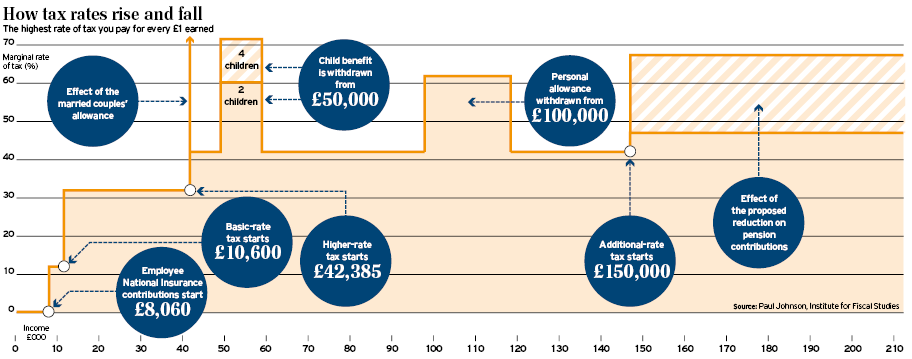
Marginal rate discontinuities in the UK income tax system [0] are driving highly undesirable (from the taxman's point of view) behaviour. The increase in marginal tax rate from £100K p.a. upwards has already led to:
- doctors going part-time to keep their income below £100K, in the middle of a shortage of doctors across the health system
- employees turning down promotions because with the combined effects of income tax, student loan repayments and loss of childcare subsidy the effective marginal rate of income tax between £100K and £117K is > 100% (!)
- single high earners (core voters of the present government) effectively subsidising families of middling earners (the opposition's core voters) because the discontinuities apply to single person's income, not combined household income
The behaviour changes are simple first order effects. The second order effects on public service workforce availability and overall tax take were also highly predictable.
If I understand the linked chart, there are discontinuities in the marginal tax rate, not the effective tax rate. So in that case yeah at certain levels the amount you owe on each additional dollar goes up, but that would not mean that making 105k is worse than 100k unless the marginal tax rate is greater than 100%.
This ignores stuff like losing childcare subsidies that is likely not included on the graph.
In the us you hear stories of people decreasing their income to be in a lower tax bracket and often it is due to them not understanding that the tax brackets are for marginal tax rates.
> If I understand the linked chart, there are discontinuities in the <i>marginal</i> tax rate, not the effective tax rate.
True, but they are harsh discontinuities, sufficiently so to have the effects I described. And yes, there is a common combination of personal circumstances (high income plus student loan repayments plus child care subsidies) which means that any gross salary between £100K and £117K means less net income than being on £99,999 gross. I've not been able find a graph for that, but the maths checks out.
The result of this particular combination is to effectively impose a ceiling on many employees at £100K gross, because they would have to receive a greater than 17% pay rise to be better off than before.
> there are discontinuities in the marginal tax rate, not the effective tax rate
This is often claimed. And the whole point of the article and much of this discussion is that no, there are often major steps / discontinuities in the overall tax rate. In the US, the many ACA discontinuities just by themselves are large and do not effectively pay attention to the bottom line. For that matter, I don't know of a single country or US state that actually "runs on effective tax rate". Which might be a solution to the problem if anyone were actually looking for a solution to the problem.
Decreasing marginal rate thresholds on UK income tax (like going from 60% at 125,139 to 40% at 125,140) is insane and leads to wacky optimisations like the following:
Suppose you predicably earn 150k a year. Taking 110k per year salary and putting 40k in your pension for four years results in less net income than:
* Taking 140k salary and 10k pension in year one
* Take 100k salary and 50k pension in years two, three, and four
In both cases you have taken 440k salary and put 160k in your pension. But in the first case you have paid highest tax rate of 60% tax rate on 40k and in the second case you paid the highest tax rate of 60% on only 12,570.
Since the annual pension allowance is now 60k per year, and you have a three year carry-forward to use unused pension allowance from previous years you can do this trick with quite a wide range of gross salaries. And you can use it for the 125,139 to 125,140 decreasing marginal rate, or the 59,999 to 60,000 decreasing marginal rate due loss of child benefit.
Note that if you are based outside Germany and you want to start a "Mahnverfahren" then you'll need to start it at the district court of Berlin-Wedding
Only do this yourself if you speak and read German well enough to handle the correspondence yourself. Otherwise you really need a German lawyer to act for you.
It is sometimes possible to agree payment of lawyer's fees according to the value in dispute instead of being billed for time spent. This can keep costs down.
Speaking from experience, there is no single, easy answer to your questions about specific measures and workarounds, because neurodiverse people are so, well, diverse. The common sense tips given elsewhere in this thread are worth trying. Keep what works. Discard what doesn't.
Listen to professionals' advice, especially OTs and speech therapists. Their work is most applicable here.
Don't listen - in fact, run away from - anyone who offers you a "cure", because they are trying to exploit you. There is no "cure" for neurodiversity. It's a difference, not an illness.
The most important thing to do for your daughter is the most obvious one: Love her unconditionally. Everything else flows from that, you just do what it takes. What that is will be pretty obvious 99% of the time.
The most important thing to do for yourself/selves is to be kind to yourself. You will need to advocate for your daughter as she grows up, and possibly beyond. You won't be effective at this if you're running on empty emotionally or financially.
> sober voices as Geoffrey Hinton sounding the alarm about super-smart AI
Can someone please explain to me what exactly the danger is / the dangers are of "super-intelligent" AI?
AIUI, an AI is a combination of hardware, software and parametrization. In broad terms, it exists as a black box which supplies to humans responses to token sets fed to it.
Even if an AI has the launch codes for ICBMs somewhere in its training data, it doesn't have an interface to the nearest missile silo to use them. It cannot commandeer the resources (hardware, space, cooling, electricity) it needs to operate, it is dependent on humans to supply those. So humans can pull the plug on it at any time.
Even if an AI were to become both sentient and nefarious, by what mechanism would it harm humans?
I'm genuinely looking for concrete examples of such a mechanism because I can't imagine any which humans couldn't trivially control or override.
I used to wonder the same, and was dismissive of the idea of "superintelligence". Now I think the whole thing- superintelligence, alignment, etc-, can be simplified a lot. Imagine you could give to someone (a random human being) the gift of omnipotence. Would you trust anyone with this ultimate power? That's the whole problem.
> Even if an AI has the launch codes for ICBMs somewhere in its training data, it doesn't have an interface to the nearest missile silo to use them. It cannot commandeer the resources (hardware, space, cooling, electricity) it needs to operate, it is dependent on humans to supply those.
How do you know the AI doesn’t have an interface to the middle silo?
Are there no military systems that are connected to the internet?
Is the power grid connected to the internet? How about our water filtration system?
I’m not worried that gpt4 is going to start launching missiles, but I also don’t understand where the certainty comes from that it isn’t possible for an internet connected AI to launch missiles.
Thank you for the reference. Its author defines a "rogue AI" as:
"an autonomous AI system that could behave in ways that would be catastrophically harmful to a large fraction of humans, potentially endangering our societies and even our species or the biosphere"
and explains that it would also need to be goal-directed in a way which would be at odds with human wellbeing.
Stipulating all that, what is still missing is an explanation of the mechanism by which an AI, rogue or otherwise, could do harm. How is it supposed to affect the world outside its computing substrate?
Absent humans making available the interfaces and resources to do so, it can't. The referenced article includes an example of a genocidal human doing exactly that, and using an AI as a force multiplier. That, as the trope goes, is a social problem, not a technical problem, and it needs a social solution, not a technical one.
Each of the other examples in the referenced article (military AI going rogue, wireheading, amoral corporate AIs manipulating humans) require AIs interfacing with the physical world outside their computing substrate or with the biosphere. Again, because these scenarios remain dependent on humans making available such interfaces, I fail to see how a hypothesized "rogue" AI could achieve any autonomy to do serious damage.
I see this panic about rogue AIs as well-intentioned but misguided, and perhaps exploited by folks who would like to control / diminish / force licensing of general purpose computing.
> How is it supposed to affect the world outside its computing substrate? Absent humans making available the interfaces and resources to do so, it can't.
True, but what more do you need than the ability to send web requests to arbitrary domains, and receive the responses?
Kinda like ChatGPT hired a person to just pass captchas, or Sydney reading news about it's own actions/interactions and therefore getting info it shouldn't have had, there's a lot of space for going out of the guardrails of not having a proper interface
Too many systems rely on people being unaware of exploits, but an AI would never forget something, or get bored or tired of trying, It doesn't need to be smarter than humans, just have enough persistence and attention to detail
> How is it supposed to affect the world outside its computing substrate? Absent humans making available the interfaces and resources to do so, it can't.
This would be more reassuring if hooking it up to a Python prompt wasn't virtually the first thing people did.
The article explains that too. But it's easy to think of millions of examples if you can hack everyone and persuade people to do stuff for you and you are smarter than them.
These aren't Meccano, they are East German "Construction" sets. A riff on the Meccano idea, but metric, and probably not paying license fees to Meccano at the time ;-) The parts will look great quality while played with only a little, but the plating has a habit of coming off in small sharp flakes if you ever bend them.
The Czech version of the page says Frank Hornby patented the metal construction set in 1901. Merkur started just before the patent expired, long before the Cold War.
Thanks for the information! These were given to my dad in the 90s by a colleague at Environment Canada. Now I’m curious how they got here from East Germany.
> One of the problems in the third world is that thugs backed by local politicians can illegally take over your land.
That's not even limited to the third world. Source: Personal experience of owning farmland in a first world country, with a mining company operating nearby, while living elsewhere myself. The only mitigation is to get involved in local politics, and to play as dirty as the thugs do. Not something you can do from far away.
tl;dr: I'd be biased towards selling, after getting a couple of independent opinions on value.


(Source: First hand experience.)