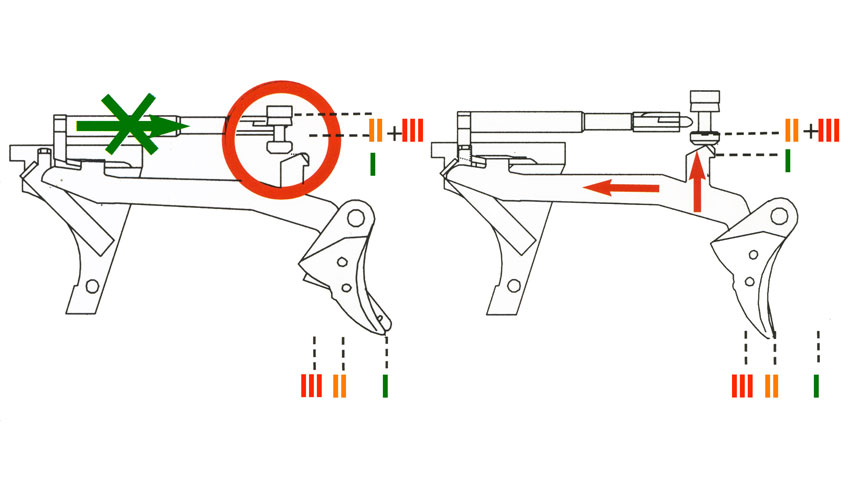
In a nutshell, the defect that causes the guns to fire when holstered occurs when there is a small amount of pressure on the trigger. If the slide (top part of the gun) is wiggled / nudged, it will fire. Also, the gun can fire when dropped. Both these issues are mitigated by other manufacturers with a trigger safety and longer trigger pull.
>Both these issues are mitigated by other manufacturers with a trigger safety and longer trigger pull.
And just not having hot dog down a hallway tolerances at the slide to frame interface.
The trigger stuff lives in the bottom half of the gun and the bang stuff lives in the top half and only goes bang depending upon the relative position of the trigger stuff. So allowing the top half and the bottom half to move around a ton is generally unwise unless you make accommodations elsewhere in the design so that you still have proper relative position regardless of where in the hallway the hotdog is.
Also, they’ve had numerous issues with their triggers failing to reset correctly and/or otherwise misbehaving. That was the focus of the original ‘voluntary upgrade’.
That this giant mess of bad tolerances, sloppy change management, iffy manufacturing outsourcing, and a design which is sensitive to these issues it seems inevitable these kinds of random and hard to reproduce problems would occur. And the more they sold, the worse it would get.
Do that in something which literally can cause death and serious injury if it fails, in an environment where all your competitors designs don’t have these issues and hence users tend towards ‘round in the chamber’ and carrying them in all sorts of messy real world situations? Guaranteed disaster eventually.
Bad sig.
The brand was dead to me many years ago (extractor snapped in the middle of a course - seemed like bad metallurgy, or a bad design), but this is entirely another level of crazy.
I think Jared's video is good at conveying the mechanics of striker-fired guns, and he is completely correct that this issue exists to some degree in every striker-fired gun (and is not an issue in them). However, the parts in the P320 have so much variance that the wall is very "mushy" on some of these guns. I wouldn't be surprised if we find that these uncommanded discharges involve both movement in the trigger and movement of the slide.
It may be the case that variance is so wide that there are some P320's which are in that "depressed to the wall" state at rest, but that would require an x-ray or CAT scan of the offending guns, and I don't know if anyone other than Sig has one. There is also a safety on P320's that should be stopping this from happening, but again, it is a part with very wide variation, and on some guns it seems it doesn't work (Sig issued a recall over this already).
I agree with Jared that this problem is a lot trickier and weirder than people give it credit for. The sort of core of the issue is that everything about the gun was done cheaply and they flew a little too close to the sun, but I believe they have no idea what in particular they cheaped out on too much.
I understand your speculation on the amount of variance, but I haven't seen any data to support it.
Sig's "recall" was a drop-safety issue, where in certain orientations the weight of the trigger could generate enough momentum to allow an unintentional discharge.
There's plenty of data on the variances of P320 parts being much larger than specified by Sig, and it has been presented in a few court cases. Root causing this issue to tolerances hasn't been done, though.
It does. This whole "small amount of pressure on the trigger thing" stemmed from a video by "Wyoming Gun Project", in which he did the exact same thing to a P320.
Glock, unlike Sig, uses a trigger safety. It doesn't just require any trigger pressure, the lever safety needs to be pushed back. Is this bad? Of course. The Sig flaw is sig-nificantly worse.
I'm pretty sure you're not implying otherwise, but it's an outrageous design flaw regardless and selling these while being aware of the problem (to the military no less!) should carry devastating consequences for the manufacturers.
Nobody is talking about the gun firing when the trigger is pulled. The gun is firing when the trigger is explicitly not pulled. Even if you're talking about the video the parent comment linked, the very first few seconds of the video show the gun discharging without a finger anywhere near the trigger. That's a deadly design flaw that in any other industry should have resulted in a full recall. Here, it was known and covered up while innocent people who made no operational error were maimed. To suggest otherwise is denying objective reality.
I think one of the best demonstrations of this, with detail on the amount of travel required for most striker-fired handguns is this video [0]. Lots of detail and relatively methodical.
So a classic sig double action or 1911 wouldn't be effected? He video says striker fired specifically. Cocked and locked I'm not sure how you would make this happen.
Hammer-fired guns have a similar issue if you drop them directly on the hammer (or on parts that can move the hammer) when the hammer is cocked. When the hammer is not cocked, there's no available energy in the firing mechanism to discharge the gun. Striker fired guns are effectively in the cocked state at rest, though. In a "cocked and locked" state, you would need the drop to disengage or overcome the safety, not just the normal trigger mechanism.
Not affected in the same way. The original M1911 design has a floating firing pin held back only by spring tension, so in theory it might be possible to get it to discharge without pressing the trigger by dropping it straight onto the muzzle from a sufficient height. This is so unlikely in practice that it's not a real concern. Some newer variants also incorporate an extra internal safety that blocks the firing pin from moving.
You have to partially pull the trigger to release the safety lever on the stiker. Once you do that, all bets are off, you have manually overridden one of the main designed safety features.
It is like saying, if you tape the trigger safety down on the Glock and drop it can go off, therefore it is a design defect.
I believe you may be confusing the type of safeties that block even intentional firings with safeties that try to block unintended firings (such as from drops or other mechanical stress). Pistols have multiple levels of safeties involved.
A trigger safety is meant to ensure that the trigger must be intentionally pulled (as opposed to moving during an impact) for the firing pin to be able to release and hit cartridge primer.
The 1911 famously has a grip safety, which needs to be depressed for the trigger to move. This is to try to ensure someone has to be gripping it with intent to fire, for it to be able to do so. While much safer than other pistols at the time, 100+ years later the design is relatively flawed, and isn’t truly drop safe, as the firing pin can still move.
The purpose of a safety on the trigger is to prevent the trigger from moving due to inertia if it is dropped. There are many different safety mechanisms on guns, this is just one, for one specific case.
Sig has good engineering videos where they walk through many of the mechanisms on the M17/18/320.
Also, does not help that the US Army does NOT want this FMECA document released. From the article that is cited the US Army's project manager & legal counsel gave this response to help Sig justify keeping the document sealed:
> The Army position would be to oppose the distribution to the public of the
> FMECA document as it potentially reveals critical information about the
> handgun (design, reliability, performance, etc.).
Wow that’s asinine. Like, russian-tier levels of lying straight to your face.
I should really know to expect less, but they yet again managed to slide under even my low expectations of sense.
Pistols are the least important weapon in a war. Their capabilities are essential identical, and you can replace every sig with a Glock and the only thing that’ll change is whose pockets the money fills.
The idea of an enemy trying to plan a battle based on the flaws of a particular pistol is exceedingly silly. Even Blackadder has gags more grounded in reality.
Army is going to try to limit distribution of any internal document, a version of deny-all security. There could be more general insights to be obtained by enemies, not specifics, and this information can add to other intel to build a theory. For example, if the pistol spec said "oh we only need 5 rounds", then that could be evidence towards Army not taking close quarters combat seriously. It would not be used to build a "just dodge 5 times then charge" doctrine.
>Both these issues are mitigated by other manufacturers with a trigger safety and longer trigger pull.
No. They are mitigated by a firing pin block that must be lifted by the full travel of the trigger, so that the block is lifted out of the way, for the firing pin to access the primer.
You forgot to mention that the gun also needs to have a bullet chambered. Not exactly how I would carry a holstered weapon, but hey, I’m 100% certain people do exactly that. Especially in a military situation so I’m not judging.
"There has to be a round in the chamber for a round to be fired" seems sort of tautological if I'm being honest.
Very, very few serious people would argue that anyone carrying a firearm should carry it without a round in the chamber. Yes, "Israeli carry" is a thing, but is almost entirely endorsed simply as a training carry-over from a time when people carried different weapons of widely varying mechanical safety features in a very unique high-threat environment.
If you're carrying a firearm professionally, or in the US "recreationally" for personal protection, carrying without a round in the chamber will be seen by most people as a pretty stupid decision.
As a Sig 320 owner, and someone that knows at least 3 other sig 320 owners, I disagree. None of us ever carry our weapon chambered. I probably know 10+ guys that own guns, including a few police officers, and I'm going to ask the officers about this because honestly, I would be surprised if they even carried their weapons chambered.
Semaglutide / GLP-1 compounding is not limited to just Hims. Lot's of pharmacies do it. The manufacturer (Novo Nordisk) charges 5x-10x for the exact same thing. The author calls the GLP-1s used in compounding "Chinese Knockoffs", but offers no evidence of quality control problems, and is instead relying on the reader's prejudices.
GLP-1 drugs may be a game-changer for obesity and diabetes, the same way that cholesterol (statin) drugs have greatly improved heart health. Hopefully reversing a long trend of increasing waistbands in developed / developing countries. Unfortunately, America will pay the highest price (including Medicare). I'm all for anything that makes them cheaper, including the many compounding pharmacies currently exploiting the loophole the author takes issue with.
Agreed. The number of times the article specifically calls out "shady Chinese knockoffs" is honestly, actually, racism. If there's evidence that Hims' drugs are harmful: Present it. The article doesn't. I know tons of people who have used Hims and companies like it, for a variety of things. I'm aware of no specific or general problems anyone has had with their medication.
That is not to say that Hims's drugs were unsafe, or that they even came from China to begin with. What I am saying, is that it's not racism to mention that Chinese products are, in fact, occasionally shady (of poor quality).
Sure; and a bunch of Phillips (a European company) CPAP machines (which had received full FDA clearance) killed over 500 people [1]. The J&J COVID vaccine gave over 100 people GBS [2]. We could go back to the 80s and pick on the Therac-25, which caused six incidents of severe radiation exposure or death [3]. And a thousand other examples in-between, of western made, FDA approved, vetted, and tested medicines or therapies that ended up killing people.
It would be stupid to believe that the FDA doesn't serve an important purpose. But, it would be equally daft to believe that even FDA-cleared products aren't, in fact, occasionally shady (of poor quality). It would be racist to believe that China is unique in the production of occasionally shady products; that the same things don't happen all the time in western manufacturing facilities.
> The number of times the article specifically calls out "shady Chinese knockoffs" is honestly, actually, racism.
Factually incorrect. A country is not a race. You cannot be racist against a country, by definition, and China in particular has a very well-documented pattern of making low-quality clones of products from other countries (often using IP stolen from those countries), so the concern is well-justified.
More generally, the use of "racism" as a response to well-justified concerns about products of a country is completely irredeemable. It's logically invalid, emotionally manipulative, breaks the HN guidelines, is blatantly anti-intellectual, and is mostly used as a propaganda technique by state actors. Please keep this drivel off of platforms like HN that are designed for intellectual curiosity.
It's interesting to consider why criticisms of China in particular are often interpreted as racism. No one makes the same accusation if you criticize America. Part of the explanation may be that China is much more ethnically homogenous: Han Chinese are 92% of the population. It seems that in the name of opposing racism, people are effectively rewarding China for being an ethnostate.
> It seems that in the name of opposing racism, people are effectively rewarding China for being an ethnostate.
My understanding of criticism of China (in particular - although I have also seen this effect with many other countries) being interpreted as racism is very different than the explanation that you provided, but that's too long to get into. Meanwhile, this is an extremely interesting second-order effect that you pointed out that I hadn't realized before. Thank you for pointing this out!
> It's interesting to consider why criticisms of China in particular are often interpreted as racism.
Astroturfing of the criticism of China = racism view is presumably a part of it. I don't consider investigating bot account networks to be a hobby of mine, so no, I don't think it's "interesting to consider."
Typically I would agree on the separation of nationality and race; but in the case of China its actually far more accurate to intrinsically tie the country and the race, given that this is the official position of the CCP.
No, it's factually not more accurate. The CCP's policies do not dictate reality, and the morally objectional ethnostate policy is both not actually the reality within China (given that about 9% of the population is not Han Chinese), and is not practiced by the majority of other nations/states in the world.
Most importantly, the author of the article is not based in China, or in any other nation that has an ethnostate policy, but in the US[1]. Therefore, even if you could make the argument that every person in China believes that states = races (which is clearly false), it still wouldn't apply to the author. Or, you know, almost anyone else on Hacker News.
So no, claiming that attacks on China are "racist" is still factually incorrect, and I really would hope that you'd invest the bare minimum of effort to verify that your claim is correct before throwing such an extreme accusation at someone.
There are concerns around safety. Compounding is somewhat controversial because they produce versions of FDA-approved drugs that are not FDA-approved, and may use chemical formulations (such as semaglutide salts) that aren't FDA-approved. [1]
The problem isn't that compounding pharmacies provide cheap versions of the same drug, it's that the compounding process doesn't produce exactly the same drug, and hasn't undergone the same stringent quality controls as Wegovy etc.
Ideally, these drugs should be cheap. The compounding is only done because there's a loophole that provides a market opportunity. The correct solution would be to improve the regulations in a way that would let more manufacturers produce safe generics.
The problem with your position is simple: where does it come from?
The legit path for compounded semaglutide is buying up Rybelsus, impacting the supply for diabetics. Compounding pharmacies are notoriously shady, and are likely using grey market materials from questionable sources.
> Compounding pharmacies are notoriously shady, and are likely using grey market materials from questionable sources.
Are they? Compounding pharmacies are common and boring. If someone hasn't yet used a compounding pharmacy then it's likely they're in very good health -- yay for them!
What's being described doesn't feel like an issue with compounding rather folks setting up shop to peddle questionable drugs.
Safe and effective. Side effects are very rare and are usually limited to soreness at the site of injection. Recommend everyone who is recommended semaglutide by a relevant authority, to get it. The obesity epidemic is a national security concern
I don't think the question was whether semaglutide was safe, but whether the version that Hims sells is safe. That includes things like being free from contaminants, stability of the compound, etc.
Hims just outsources fulfillment to a compounding pharmacy. Usually they add vitamin B-12 to make it "customized". Are they crushing rybelsus? Getting raw materials through some mysterious supply chain from Ukraine, China or Israel?
You have no idea.
On the flip, I think access to basic drugs for stuff like ED, hair loss, etc is fine. But they also do stuff like off-label anti-depressants, etc can potentially be dangerous... but at the same time, people are going to urgent cares and getting antidepressants with just more cost and friction.
> I don't think the question was whether semaglutide was safe, but whether the version that Hims sells is safe.
Don’t forget “effective” too. If you just make the bar “safety” then you are accepting sugar pills as medicine for whatever condition. You should need to prove both safety AND effectiveness.
Yup. And using it as the wonder drug it is, I.e women using it to get “beach bodies” should be celebrated and not stigmatized.
I want bodily autonomy and control. The right to experiment with weight loss drugs is analogous to the right to be trans or to not have your foreskin removed at birth.
It’s crazy that these drugs even have further benefits like anti addiction properties!
Semaglutide is linked to NAION, a "stroke" in the retinal blood vessels linked to a blood pressure drop there, typically when sleeping. I think I already have one of these in one eye. I DO NOT want to risk getting it in the other. Staying off semaglutide until it's really necessary.
There’s a bunch of material out there including acknowledgment from the association of compounding pharmacies.
They are in general shady, and the Florida pharmacies are notoriously under-regulated. Guess where most of the online dick pill outlets do their compounding?
No, this doesn't imply an "infinite amount of money", it's just a pricing model.
You still need the parameters of the distribution (brownian motion / random walk), and these are unobservable. You can try to estimate them, but there is a lot of practical problems in doing so, primarily that volatility / variance isn't constant.
Your post is completely off-topic. The paper includes a great discussion about how the property insurance crisis in Florida dates back to Hurricane Andrew in the 90s, not a court decision in 2017. The issue raised in the paper isn't climate change, its weakly capitalized insurers and the conflict of interest created by one particular rating agency (Demotech), that is giving sketchy insurers clean bills of health that allow them to operate.
Tort reform in Florida is a bandaid. The state-run insurer is creating serious market distortions by undercharging for the risk, accumulating very large proportions of the state homeowners insurance policies (since no one else will), and then offloading the policies to undercapitalized insurers while looking the other way about their poor financial condition. When Citizen's claims are in excess of its reserves, the legislature steps in and taxes the rest of the state to cover the shortfall. I'm guessing when the other insurers become insolvent, the shortfall is offload to the state guarantee fund (possibly on the taxpayers dime). This is all covered in the paper.
When you buy health insurance, you sign a temporary HIPAA release (limited duration) to cover the period that they are underwriting. They can only query your specific pharmacy records for the purposes of underwriting. So yes, this is a HIPAA violation when it is being used by the police. I work in this space with HIPAA data.
> Required by Law. Covered entities may use and disclose protected health information without individual authorization as required by law (including by statute, regulation, or court orders).29
> Judicial and Administrative Proceedings. Covered entities may disclose protected health information in a judicial or administrative proceeding if the request for the information is through an order from a court or administrative tribunal. Such information may also be disclosed in response to a subpoena or other lawful process if certain assurances regarding notice to the individual or a protective order are provided.33
> Law Enforcement Purposes. Covered entities may disclose protected health information to law enforcement officials for law enforcement purposes under the following six circumstances, and subject to specified conditions: (1) as required by law (including court orders, court-ordered warrants, subpoenas) and administrative requests; (2) to identify or locate a suspect, fugitive, material witness, or missing person; (3) in response to a law enforcement official's request for information about a victim or suspected victim of a crime; (4) to alert law enforcement of a person's death, if the covered entity suspects that criminal activity caused the death; (5) when a covered entity believes that protected health information is evidence of a crime that occurred on its premises; and (6) by a covered health care provider in a medical emergency not occurring on its premises, when necessary to inform law enforcement about the commission and nature of a crime, the location of the crime or crime victims, and the perpetrator of the crime.34
> Essential Government Functions. An authorization is not required to use or disclose protected health information for certain essential government functions. Such functions include: assuring proper execution of a military mission, conducting intelligence and national security activities that are authorized by law, providing protective services to the President, making medical suitability determinations for U.S. State Department employees, protecting the health and safety of inmates or employees in a correctional institution, and determining eligibility for or conducting enrollment in certain government benefit programs.41
I work in this space, and your comment is completely wrong. Data covered by HIPAA is always covered by HIPAA. A covered entity would also include a health insurer, and all payment intermediaries, this is straight from the HHS faq (https://www.hhs.gov/hipaa/for-professionals/faq/covered-enti...)
I don't think you read the article or the links you provided. It clearly states the police are obtaining this information through subpoena and not warrants:
In briefings, officials with America’s eight biggest pharmacy giants — Walgreens Boots Alliance, CVS, Walmart, Rite Aid, Kroger, Cigna, Optum Rx and Amazon Pharmacy — told congressional investigators that they required only a subpoena, not a warrant, to share the records.
And in the link you provided:
When might it be permitted for a pharmacy to disclose PHI to law enforcement officers?
Bearing in mind that, once in a designated record set, PHI could be an individual´s name or physical description, a pharmacy (or pharmacy staff) is permitted to – but not required to – disclose PHI to law enforcement officers in the following six circumstances:
as required by law (including court orders, court-ordered warrants, subpoenas) and administrative requests
In this case, the leeway in the standard here is what the pharmacy chooses to comply with. They are choosing to comply with subpoenas. This article points out how that standard could be higher (warrants).
You keep dropping links for me to chase instead of just reading between the lines. Police cannot issue their own subpoenas. Police are not judicial officers. However, they are getting judicial officers to write their subpoenas. A judicial officer does not have to be a judge, therefore the standard is lower than a warrant.
I think there is an additional reason here too. Software development work is (too often) seen as heads-down, anti-social work. Large corporations often bridge communication between software developers and the business/end-users via third-parties, such as product owners/manager, architects, and business analysts. Remember the "telephone" game we all played in kindergarten, where a message whispered between participants becomes comically unrecognizable by the time it reaches the last person? That is BigCorp software development in a nutshell.
Solving this communication problem is uncomfortable. Connecting software developers with end-users is hard. It means software developers have to have courage to ask "dumb questions" when the end-users explains something too quickly in jargon-laden terms. It means that end-users have to be patient, with the time to teach and explain enough about the problem domain. People with strong communication *and* technical skills are hard to find, and creating ongoing mutual respect and cooperation between end-users and the oft-hated IT department is only possible when employee attrition is low enough to create long-standing relationships.
Software development is fun when it is a high-momentum, self-contained exercise. So we direct our energy to complexity, because its fun and safe. We don't need to stop and engage with end-users who speak a language we barely understand. We don't need to create consensus among disagreeing end-users representatives. We just need put on some good music, drink some coffee, and solve clean technical problems, rather than messy people problems. I'd guess most software developers would say "you don't pay me enough to deal with people", and walk away.
Hi yold_. It is made heads-down anti-social work by simple minded managers. They create infantilized environment that self-select for devs that don't like to talk to people.
Talking to people is trusted to "big boys" from business. You've listed the roles. Business big boys will sell complexity to clients through IT woo wooo. More complexity - more revenue.
I guess the most useful understanding from my post is that it is by design. It didn't "just" happen. Corporations bread them and make it a norm. This proliferates an understanding of a dev as an infantile that plays with himself.
Thank you for showing me I probably didn't articulate that understanding well enough.
> Generally they make 25-50% more than a similar level vanilla software engineer.
It's often even less in my experience. Despite having a "unicorn" skillset (soft-skills, advanced degree, domain experience, and SWE experience), I make about as much as a vanilla SWE. There are a huge number of inexperienced PhDs that want into the field, and we are flooded with resumes every time a DS leaves. Also, most of the time, models don't really matter. What makes or breaks most DS projects is soft-skills, stakeholder management, and data cleaning / feature engineering.
> Also, most of the time, models don't really matter. What makes or breaks most DS projects is soft-skills, stakeholder management, and data cleaning / feature engineering.
I have the same impression. I did my Master's degree in data science, but I quickly realized that coming up with ideas and running the models is the easy part. Doing the engineering work + synthesizing everything such that value creation occurs is more difficult.
I'm happily doing mostly data engineering + stakeholder management instead of hyperparameter tuning.
>I'm happily doing mostly data engineering + stakeholder management instead of hyperparameter tuning.
Agreed. I actually like that in DS you can have a job where you are involved in the end-to-end of a business problem and that you need to have a mix of skills (e.g. Act like a Product Manager and an Engineer) to succeed. And it's not just "Today I get to crank out yet another tile on the Kanban board."
Sure "Machine Learning Research at top tier AI company" is a different boat.
I'm talking more about "Data Science/ ML Department at a typical company". You won't see salaries above comparable SWE roles there. Most likely, the SWEs will be better off.