Either China can abide by international laws and actually enforce IP prosecution on strategic domestic companies, or they don't deserve to play at the free trade table.
The "Well, we know the Chinese government is unfairly tilting the domestic economic market in favor of local companies, but if we give them a seat at the table then eventually they'll change" is never going to be realized when they're treated with kid gloves by everyone who wants access to their market.
And now that China has a number of internationally competive industries, it seems like as good of a time as any to press harder.
For all the bullshit that made it's way into the TPP, it was strategically a good idea. Multilateral tariffs are the only real pressure that an economy as big as China's will feel.
And for all the people that complain 'but the prices will go up', yes they will in the short term. But don't underestimate how quickly it would be for the factories owned by multinationals to move out of China to even cheaper countries like Vietnam or India, or move back to US to cheap states via robot factories. Prices will go back down to equilibrium soon.
Rising prices would be good if (and only if) they caused increased wages or employment. We need a lot of wage inflation to reprice the economy so that real estate, college, etc. are reasonable again. Either that or those things need to fall, but that's usually more painful.
wage inflation will happen soon enough. there a flood of money flowing back to US (from emerging countries) due to global instability, repatriation tax decrease, tariffs, default risks in emerging countries, and increasing interest rate. alot of money are flowing into the cheaper states in US besides just California and New York.
Fed Says U.S. Labor Market Near or Beyond Full Employment
It's a bit scary but if you look at house prices vs median income in most cities you'd need at least 2X-3X inflation to fix the discrepancy. We may well see early 80s inflation soon.
Houses and rent will be reasonable again. A loaf of bread will cost $12.
Is this really the whole story? To be honest, I haven't gotten the read that "money is flowing back into the US". a few points.
- Repatriation is one time. We will likely continue to run a deficit, tariffs aside.
- I'm seeing increasing news that ex-us investing is being favored[0], and that some of our largest purchasers of treasury bonds are considering scaling back[1]. Meanwhile, the EU has been pushing more and more for ways to get "their cut" via taxes and fines, although long-term impact of this is largely TBD.
- Although you link re: low unemployment (accurately) this only tells half the story, as labor participation rate continues to be heavily depressed. (~61%) [2].
- Finally, I'd also like to rebutt the "money flowing into cheaper states" but am having a hard time finding articles on the data I'd want, namely that most of the investing I had heard was in low-employment highly-automated factories and datacenters. (From a purely logical standpoint, the hiring advantages in a high tech economy of concentrations of workers isn't going away any time soon, and housing prices, despite tax changes, seem to align with this, although that may take a while to see a shift) I could certainly reinforce the assertion that poor states aren't in a great situation by the trend of needing to cut back to 4 days of school in some places [3] (A topic I'm surprised hasn't gotten more attention on its own, tbh)
I think my takeaway from this would be that I'm not so confident we'll see wage inflation, at least not _nearly_ to the level to which housing is escalating. It'd depend on a ton of factors, including population concentration, wage vs housing increases, employment changes, and black swan events, so obviously I can't make a holistic statement, but the points I list above make me much more pessimistic that the environment we've seen over the last 20~ years will likely continue, including the long-term crash-based financial cycle.
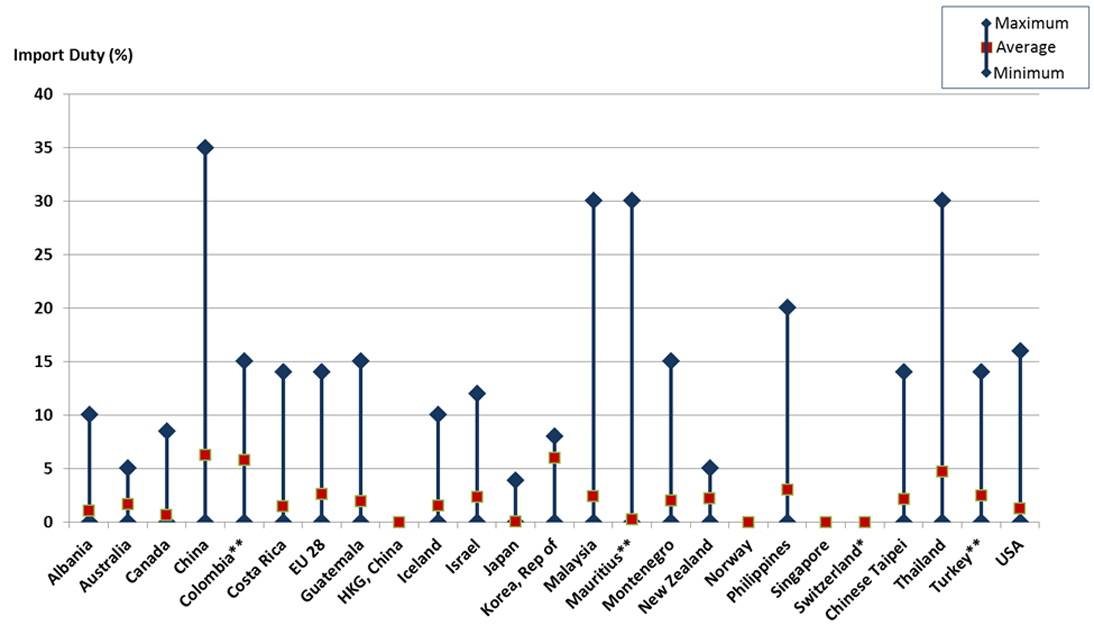
Note any outliers? Without digging through the legalese, it would seem the US could triple import tariffs on a large swath of IT products and still be on par with what China's charging.
I can't imagine the WTO would look too favorably on a case from China if the US simply pegged reciprocal tariffs at an equal rate.
Sorry if I didn't make clear that the question was rhetoric. Thanks for your effort linking to a good explanation. I hope that answers the question of why it is not legally viable to use tariff to create pressure unless it is through WTO compliant cases.
I get that you’re being fascetious, but there are many Chinese manufacturers who will copy a product for you if you ask nicely (i.e. want a large enough volume to make it worth their time). The other common way this happens is ODMs there simply produce more of an order for a customer and sell it unbranded or under some made-up brand name. This is partially why you see so many products on Amazon with names like WinBuyer, iEnjoyWare, GooBang, Anewish, Globmall, GooDee, APEMAN, etc etc (those are all real examples). Amazon does sometimes step in and eat their lunch with AmazonBasics versions of common products (car top carry bags, camera cases, many home goods, etc). I personally do go for the AmazonBasics brands in these cases, since while they might be from the exact same factories as the GooBuy3000 version, I have higher confidence that I’ll be able to reasonably return it if it’s terrible, and moderate confidence that it’s at least a passable version of whatever it is (e.g. I own an AB umbrella and many batteries, all of which are decent).
I actually was not being facetious, I was flat out accusing the Chinese government of industrial espionage. There is a difference between a company copying ideas and implementing them independently vs straight up hacking and stealing secrets. Everyone does the first, China does the latter on a massive scale.
Its never been about hoping they’ll change. It’s been about their size dwarfing the West’s. Maybe NAFTA was meant to create a trading alliance to rival them, but it clearly didn’t work well enough.
and now we can clearly see that there was never going to be a middle class in China. Too much money stolen and given to communist party (and now the dictator).
"Seventy percent of young adults in China are homeowners, according to a recent HSBC survey. The study, which looked at more than 9,000 people born between 1981 and 1998 in nine countries, found that the home ownership rate of Chinese millennials is nearly double the global average."
> By the end of the decade, there will be more than 30 million more adult men on the dating market than women. [...] “Parents and grandparents will often pool their money together to invest in that child by buying a property in that child’s name.”
You claimed that there is no Chinese middle class. Are you saying home ownership is not a sign of middle class? I did not claim China is rich or even well off by US standards.
China has already bailed out several upper tier cities housing markets several times. This is not the measure of economic health people take it for, at least, not in the current regulatory environment of China.
At least, you can cherry-pick two who think so (that is how many economists are quoted in the article). On the other hand, you can probably find two economists who will say almost anything. I'm more interested in surveys like the ones the IGM Forum conducts. Here is what they think about the aluminum and steel tariffs:
Yeah, you’re telling us the tariffs won’t work and people don’t agree with them. How about we back up and discuss the degree to which China is or is not being fair in trade.
Elon Musk, for example, wants certain tariffs because China has a 25% tariff:
Sure, they're good for his business. Tariffs are generally good for the industries they protect, at the expense of consumers, because prices will rise in that industry. So one industry and it's employees receive protection from foreign competition, but consumers "pay for it" on the backend with higher prices.
That's a one-dimensional view. We are not only consumers. We're also laborers, and citizens of a nation. If every other nation has tariffs, and the U.S. doesn't, then it's not a level playing field and industry and capital will leave, as we have seen. It's important to national security that the U.S. maintains its manufacturing base, and personally, I'd rather pay a little more for American goods if that means the working class doesn't descend into poverty, which is costly in other ways.
Maybe understanding what MFN status https://en.m.wikipedia.org/wiki/Most_favoured_nation means would help resolve arguments like this. Of course US is free to set tariffs at a level it sees fit (in accordance with its international agreements) as long as such tariffs apply to all trading partners (who are WTO members).
Of course tariffs won't improve the welfare of Americans. Removing those tariffs after China has changed its illegal and unfair trade practices is what is suggested to improve the welfare of Americans.
"Fair" is a bullshit notion when it comes to trade. What Americans say is that China can produce <insert commodity> cheaper than the USA only because "it's subsidized", and that's unfair.
What exactly does it mean to say that is "unfair"? The USA for example subsidizes their soybean exports, is that "unfair" to the rest of the world?
Their society spotted a strategic opportunity in collectively working together to lower the prices of some exports. Now, it might make sense for the USA to apply strategic tariffs. But calling their decision "unfair" is just filler word nonsense, as we're all playing by the same rules.
You seem to be focusing on one rallying point of the protectionist agenda (subsidized production), and not the underlying predatory trade practices.
See, there are unfair trade practices, even if you think your example isn’t - practices such as dumping, or outrageously high unilateral tariffs. These destabilize global economies, and are used specifically to damage foreign industry. These are not simply a matter of ‘strategic opportunity’, which is why they are generally forbidden by international trade groups.
Of course they don’t actually get to do much to enforce international law at the WTO, but that’s a different story.
You make some good points. I agree. There are differences in subsidies. For example. It may be ok to subsidize food production so that a country can ensure continued ability to maintain production capacity domestically, even where it’s not economically viable. But that is very different from a country strategically subsidizing an industry with the objective of marking the products so low priced that they drive all the domestic producers out of business and then, when they are left standing, jacking up the prices. That’s called dumping. There is a reason we have the WTO and a dispute resolution process, it’s be cause some things are ok and some are not.
No we're not. If China wants to make an anti-dumping case over our soybeans to the WTO, they're welcome to. So far, they haven't. Mostly because they're going to have to make a case that "crop insurance" provided by the USDA is somehow an undue "subsidy."
> How many billions of totally-not-subsidy are you not subsidizing?
Roughly: 2 Billion on an export crop that's worth 35 Billion at market. Is that noncompetitive support to spurn dumping in a foreign market? Obviously not, and it's why China didn't go to the WTO already.
It would have been better 20+ years ago, before wholesale IP flow there and some other places.
There was theft. There was also taking advantage of that theft by "Western", "IP friendly" businesses. Hardly the only, but one of the reasons that "outsourcing" had such "cost savings". Because the suppliers outsourced to weren't actually paying for the tools and technology they were using (versus e.g. a domestic U.S. producer).
It would have been better 20+ years ago, before wholesale IP flow there and some other places.
There was theft. There was also taking advantage of that theft by "Western", "IP friendly" businesses. Hardly the only, but one of the reasons that "outsourcing" had such "cost savings". Because the suppliers outsourced to weren't actually paying for the tools and technology they were using (versus e.g. a domestic U.S. producer).
P.S. I'm all for the "third world" -- or "second", or whatever -- advancing. I don't think nor respect the idea that the "first world" had to hollow itself out to accomplish this. Nor so distort other societies and governments into such abusive forms, e.g. by using our technology to empower an abusive but cooperative faction over the others.
But then I've been an optimist. The last some years of U.S. politics have really put that to the test for me, personally.
IMHO, Trump's idea on tariffs and China is not really about trade, free trade, or economics. Instead, Trump's ideas go back to some simpler stuff -- predatory marketing to achieve and then exploit a monopoly. So, run losses, drive competitors out of business, then take all the market, have a monopoly, and raise prices. Also for China, much of the goal is international power.
China is like the guy who promised to catch the wild pig. So each day he took a walk in the woods and left a trail of corn. Soon the pig found the corn and started following the corn trail. Slowly the corn trail led to a corral with an open gate. So, sure, as soon as the pig was inside the corral, the guy closed the gate. Done. One pig captured.
China doesn't want trade or free trade; instead, China wants to use "the old take over the world ploy". So, China will try to reduce everyone else to colonies supplying goods, especially from agriculture, at low prices while they import products from China at high prices. That idea used to be called mercantilism, e.g., what England did to India.
The Chinese Communist party is willing to have their citizens work however long at whatever work to support their "old take over the world ploy".
For the US, the situation is easy: Slap on tariffs.
The US tariffs will also be good for the Chinese people -- have the Communist party keep the Chinese people busy making consumer products, concentrating on education, a nicer country, etc.
China is a big country with lots of land area near by -- Mongolia, Russia, India, SE Asia, Australia, etc., and doesn't much need to import anything and needs next to nothing from the US.
Similarly the US needs next to nothing from China.
The US tariffs will also be good for the US, e.g., put many millions of US citizens back to work. In many ways, the US standard of living was much higher in 1950 when foreign trade was not very important for the US.
Besides, just why should the work output of US workers be shipped out of the US? Really, only if that output can be swapped for something more valuable to the US, e.g., products we need and don't have, e.g., tin, natural rubber, teak, but there isn't a lot of such products the US really needs. Okay, we could sell the output for gold, sell the gold to the US government, and let the gold accumulate in Fort Knox. To what end? Fort Knox is awash in gold.
I know; I know; I know: The big plan was that poorly paid US workers would give their jobs to China, India, Pakistan, etc. and, then, get much better jobs at Microsoft selling software at high prices to China, India, Pakistan, etc. Well, mostly it didn't work: Instead the textile workers in the Carolinas are still out of work; same for the steel workers in the Rust Belt, etc.
Why? Some US foreign policy thinkers thought that such trade would make a more peaceful world. The people doing the importing liked making the money. Pakistan liked getting US help setting up a textile industry and selling back to the US to get cash to buy, say, oil or stuff to make their atomic bombs. Bummer.
Trump is correct: China has devastated large areas of the US fly-over states. The whole show, from Nixon's trip to China to China in the WTO to the present has been a disaster in nearly every sense for the US.


Either China can abide by international laws and actually enforce IP prosecution on strategic domestic companies, or they don't deserve to play at the free trade table.
The "Well, we know the Chinese government is unfairly tilting the domestic economic market in favor of local companies, but if we give them a seat at the table then eventually they'll change" is never going to be realized when they're treated with kid gloves by everyone who wants access to their market.
And now that China has a number of internationally competive industries, it seems like as good of a time as any to press harder.
For all the bullshit that made it's way into the TPP, it was strategically a good idea. Multilateral tariffs are the only real pressure that an economy as big as China's will feel.