Harmony is an important concept in East and West -- and it has a much more specific meaning than "goodness."
It played a major part in western philosophy (Pythagoras and Plato), where it was hypothesized that a mathematical harmony pervaded the cosmos. The first empirical -- even scientific -- hypothesis testing investigated this idea [0] using proportional lengths of string and the thickness of bronze chimes. Contemporaneously in China, both Confucianism and Daoism treated harmony as an underlying moral/aesthetic principle. The union of moral and aesthetic harmony was described in the thesis of Francis Hutchison, who was both Adam Smith's doctoral advisor and one of the biggest philosophical influences on the American founding fathers. See for yourself! [1]
Harmony is not sameness -- it is diversity in unity. This is a key insight in both Eastern and Western philosophy. In the West, the connection to the mathematics of the harmonic series doesn't appear to be coincidental (harmonies consisting of notes that share harmonics) -- although I'd challenge anyone to make sense of it all! My point here is that there is a story worth learning more about. I'd argue that we need guiding philosophical principles -- and it is awfully nice that there is a scientific one that underpins some of the largest societies on Earth:
* The official principal objective of the Chinese government is the creation of a "Harmonious Society".
* The official motto of the EU is "In varietate concordia"
* The traditional (although unofficial) motto of the USA is "e pluribus unum"
* The official motto of Indonesia is "Unity in Diversity"
* And now this from Japan!
Not to say that these governments are necessarily aware of this history, but only that these ideas are very old, very core and very unifying.
[0] Barker, A. (2007). The science of harmonics in classical Greece. Cambridge University Press.
[1] Hutcheson, F., (1729). An inquiry into the original of our ideas of beauty and virtue: in two treatises. I. Concerning beauty, order, harmony, design. II. Concerning moral good and evil.
The Chinese character for harmony is 和. The Japanese character 和 does represent Japan. The usual Chinese character that would represent Japan is 日; 和 is used in expressions taken from Japanese like 大和民族, the Japanese race.
Amusingly there's a pun here on "Zero-sum Era". This because "rei" is a common way to read the numeral zero, and "zero-wa" (using the same "wa" from the new era name) is the Japanese term for "zero-sum".
平成 (Heisei) commonly translated to "Achieving Peace" as stated in the article, can also be read as "Flat Growth" which is more indicative of the past two decades here :)
No, because nobody cares about the sound. The kanji matters. Soundwise there are tons of kanji with the exact same pronounciation so there is no pun to be found.
I think the biggest problem is that if you type "reiwa" in an IME, 令和 wouldn't be shown as a suggestion because it wasn't a real word before. You'd have to write each character separately.
I'm pretty sure IME updates take care of it just fine... when I woke up this morning and tried out Microsoft's Japanese IME after finding out the new era name, れいわ became 令和 on the first try - no messing around with the "misconversion" data necessary.
Despite that, Gboard's Japanese version hasn't caught up yet, but I imagine that'll be updated fairly quickly, either manually or OTA.
This is no different from entering a name of someone written with a less common combination of kanji. You can either enter the word phonetically and pick the kanji you want (this trains the IME), or manually add an IME dictionary entry.
I fully expect all IME's in common use to have updates for this within days, if not already.
Anyone else gets display issues with 令? It shows up incorrectly in certain android locations (keyboard, hangouts) but looks fine in firefox. The stroke order illustration on jisho also has the last stroke wrong [1]
This might be a problem arising because of Han unification.
In Japanese, the character is commonly written with a vertical final stroke (at least in print), whereas in Chinese it's a diagonally down and to the right. However, they are encoded as the same in Unicode. What gets displayed depends on the font choice, possibly aided by somewhat hacky language hints.
This particular character is the second example in the list of "Examples of language-dependent glyphs" in the Wikipedia article [1].
Speaking of this, my computer just switched from displaying Chinese by default to displaying Japanese. I was able to configure Firefox back to Chinese, but couldn't figure out how to set Windows 10 back. It only really affects me if I happen to be typing Chinese in Notepad, but still, it's annoying. Do you know how?
Jisho does not have the last stroke wrong, that is how you write the kanji. The way it is represented in computer fonts is different than how it is hand written. The jisho instructions show how to hand write it.
The confusion probably stems from the way it is written in the calligraphic representation of 令和 presented by the government, which does do the same vertical stroke as in print.
In normal handwriting マ is totally fine and common.
Yep, exactly! Certainly no expert on Japanese, just the only place I saw it written with the マ shape was my android device and jisho, so I assumed it was an error. Learned a new kanji today anyway!
This is basically just a font difference. The angular version (in the text of your link) is the more typewritten style, while the version in the stroke order graph is the more handwritten style.
It's roughly analogous to the way "g" would usually descend on the right when written by hand, but descends on the left in most typefaces.
Are there any developers with Unicode experience able to comment on this? I know the character for Reiwa has been reserved but I’m unsure if programmers are familiar with Y2K-esque bugs that could happen.
The new name just uses standard characters, but what you're probably referring to is the fact that Unicode 12.1 will have a character for the two of them compressed into one glyph.
The square / single-glyph version is only used in some / limited contexts, in most contexts (including the emperor's eventual posthumous name) heisei would be written and displayed "normally".
I'm not competent to answer that, but the "merged glyph" versions of the other four modern era names date from older encodings like EUC and shift-JIS, and are presumably in unicode for compatibility. So the rationale for adding a new one may just be extending that set.
It's a combination of two existing characters, the rei as in meirei/命令 (order, command) and wa as in heiwa/平和 (peace, harmony). No new characters need to be reserved.
Huh, according to Jim Breen's dictionary (http://nihongo.monash.edu/cgi-bin/wwwjdic) 'good, fortunate' is '礼' (rei). '令' (rei) is listed as 'command, decree'. The official character that is being used is '令'.
Is there some rule or convention that explains why 令 means 'good, fortunate' here? Is it due to the usage in the 7th century poetry that is referenced in the article?
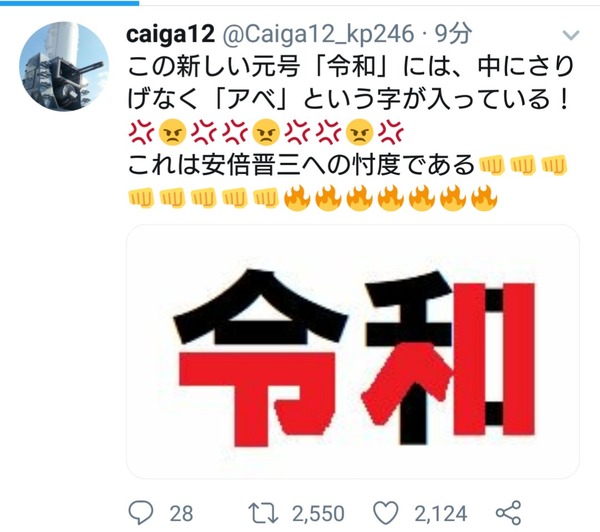
Even though there's an explanation, I've seen a bunch of negative reaction to the name from Japanese people online because of the association with "command", also linking it to the current prime minister and his relatively militaristic politics.
If we have to trace back even further, it can date back to the ancient Chinese classic, the Classic of Poetry, where it is being used as good/respectful:
> Are there any developers with Unicode experience able to comment on this? I know the character for Reiwa has been reserved but I’m unsure if programmers are familiar with Y2K-esque bugs that could happen.
They create a brand new character for the era names? I find that a little hard to believe, because Wikipedia [1] already has the Reiwa era listed and my computer has a font that can display the kanji for it.
http://blog.unicode.org/2018/09/new-japanese-era.html was posted here yesterday, but the short answer is that the era can be referred to using two existing characters (for the current era: 平成) or with one new combined one (㍻). Wiki is using the former, so it doesn't need software support.
Aside from the new combined glyph, One potentially major issue is that the character 令 exists in two locations in Unicode: U+4EE4 and U+F9A8. The latter is a compatibility variant, and depending on the how smart the text processing code used is, it may or may not be considered equal to the former.
Hence, that's now one more thing to test and work around for the poor engineers working karoshi hours, only given one month to implement changes on and test the ungodly numbers of computer systems all around the country.
Really, this one-month compromise between conservatives and engineers was pretty much the worst possible result: too short to work with any breathing room, too long to throw up hands and abandon the idea of implementing it in time.
Because this stuff is hardcoded into the standard library (at least in Java I know it is) and I assume it's the same for other things.
For example any dates in the future like 2020 will show up wrong. Where it ought to be reiwa 2 it will be Heisei 31 which doesn't even exist.
Heaven forbid you were doing something crazy like matching on strings for the date etc you could get into a world of hurt.
Mostly though you always work with real, actual dates and use the standard library support for the Japanese era date to calculate outputs for display only. Mostly it just means there are a few forms/invoices out there with a non-existent date on them but oh well.
I'm now imagining some kind of action movie where the emperor lives too long and a band of programmers have to assassinate them lest their code breaks.
I'm a chinese speaker, this new era name sounds kind of weird. When written in kanji, the previous nengos (meiji, taisho, showa, heisei) makes sense, and you can kind of tell the message it tries to convey. It just feels weird to me to concatenate "rei" and "wa" together.
What'll you do when you get lonely,
And nobody's waiting by your side?
You've been running and hiding much too long.
You know it's just your foolish pride.
Reiwa, you've got me on my knees.
Reiwa, I'm begging, darling please.
This is weird. I thought this was an April Fool's joke. 冷戦 means cold war, so 令和 would mean cold peace. Not that this has an actual meaning but if we assign one it's not very positive, i.e. things will appear unpeaceful and there will be wars, but actually this is peace, in the background.
Not that this is the meaning they chose, but I find it just a bit curious.
令 and 冷 are different characters. They only have the same reading, from their common 音符 (onpu), 令. Other characters with the same onpu: 零, 玲, 怜, etc. All these characters have different meanings.
This is stupid. Make no mistake: this is not the Japanese "culture". Most private organizations in Japan have already switched to the Western calendar, and its only user is the Japanese government (although it's one of the biggest ones, sadly). They should stop wasting their time and energy for this farce.
And yes, one could argue that this will create extra IT jobs that would be unnecessary if they abandoned the system, as this will affect so many legacy systems. Also it will please certain nationalistic right wingers here. But nonetheless it is a self-imposed complexity that we could opt out if we were smart.
For what it’s worth, Japan is not unique in using different calendars in different contexts.
There are several calendars in India, all based on the moon. In my state within India everyone uses the Gregorian calendar for most things except in certain cases. For example, no marriages happen during the month of Margazhi (December 15th - January 15th).
There’s no conspiracy in using a different calendar. It’s just a continuation of a cultural practice that hurts no one.
The difference is that in India nobody uses the traditional calendars outside religious contexts, while in Japan the nengo dates are used for everything from yogurt expiry dates to government forms.
it is a self-imposed complexity that we could opt out if we were smart
You could say that about a lot of things in a lot of countries. You have to think twice before you throw away such an old tradition that connects people to the past and the history of their culture.
Most Japanese people I know are either ambivalent or happy about it. No one is suggesting doing away with it.
You do know that plenty of other cultures around the world have their own calendars and these (like Japan's) coexist just fine with the Western calendar, right?
I'm Japanese, and while I don't exactly suggest doing away with it completely, I don't think it has a place in the vast majority of information processing going on in society today.
These Gengō updates force a massive, MASSIVE number of date entry forms (both paper and digital) -- from banks to government offices to driver's licenses to middle school soccer club application forms to just literally ANYTHING else imaginable -- to update to new versions including the new era name, resulting in so much wasted resources and taxpayer money every time it happens. Sure, standardizing all forms to the Gregorian calendar will also cause a mess, but at least that would only happen once. (A lot of those forms have already voluntarily switched to the Gregorian calendar, but a huge number still continue to use the Gengō notation, especially government-related forms.)
The Gengō era system even left us our own version of the Y2K problem: Back when legacy mainframe systems were being built, there were systems that recorded the year internally using the Showa era count (Showa 1 = 1926), and was kept that way even after the Showa era ended in 1989 and Heisei rolled around. Such systems will reach year Showa 100 on 2025, where unfixed systems could act weird much like with Y2K.
Also to note is that conservatives in power were very strongly opposed to publicizing the new era name ahead of its implementation (citing "tradition"), completely ignoring the reality of modern-day IT infrastructure requiring time to implement code updates and test their systems against all imaginable edge cases. As a compromise, they ended up giving one month advance notice (The new era goes in effect May 1), but this is way too little time.
So I'm fine with the Gengō counting system being used in casual conversation or formal imperial rituals and such, but those are about the only things I'm fine with.
> These Gengō updates force a massive, MASSIVE number of date entry forms (both paper and digital) -- from banks to government offices to driver's licenses to middle school soccer club application forms to just literally ANYTHING else imaginable -- to update to new versions including the new era name, resulting in so much wasted resources and taxpayer money every time it happens.
The early Babylonian system was to give each year its own name. This has really helped us, thousands of years later, to develop an accurate chronology of the period.
If Japan used that system today, do you think the per-switch cost of switching would be higher or lower? How about the per-emperor cost?
At least 80% of the forms I fill out in Japan will ask for era year. It’s easier for me to say aloud, too: “showa yon jū hachi” versus “sen kyū hyaku nana jū san nen”.
Is it really such a big deal? It's not like they're _introducing_ regnal eras, it's just a new era name for the system they were already using.
BTW, both this comment and the article hint at a connection with right-wing nationalism. I won't claim to understand Japanese politics, but AFAIK Abe's government is increasing immigration to Japan to far higher levels than ever before. Surely that's going to have a far bigger impact on Americanizing Japan than retiring era names ever could, isn't it?
The article refers to Abe's government as "ultra-conservative", not as "right-wing nationalist". I would not say that Abe is nationalist in the normal definition of the word. Japanese politics tends towards right wing, though it tends to be more of an old school conservatism: old money, but with a sense of responsibility towards the people. So, for example, there aren't a lot of services performed by the government and it is expected that businesses somehow voluntarily pay to have these things done. In my rural town the government does not mow the sides road, or trim branches on trees, or maintain the parks. That's pretty much all done on a volunteer basis by local businesses, or residents. There is a big rota and you have to go out once a month and do some work.
Financially, things are conservative as well. Abenomics is literally Reganomics with "Regan" replaced by "Abe" -- trickle down theory and all. And it works just as well as Reganomics didn't too ;-) Abe has also been quite busy trying to rewrite the constitution so that Japan can get into international conflicts where their allies are involved. Previously Japan was only allowed to get into conflicts where Japan itself was under threat. There is some speculation that the emperor only abdicated in order to force the government to do a bunch of constitutional work and delay the constitutional work that Abe had ordered. Abe managed to survive a general election, so if that was the goal it ended up being fruitless.
In terms of nationalism, I don't think that Japan (or its government) fits the definition. There are protectionist attitudes towards food trade, but that is understandable given that more than 1 million people starved after WWII due to the fact that Japan had imported most of its staple foods at the time and got blockaded. There are actual laws that date from the end of WWII that enforce this protectionism, so it's hard to blame the current government :-)
There are, of course, nationalist people in Japan (and even nationalist political parties), but they do not represent Japanese mainstream thinking in any way shape or form. It is very much the loony fringe.
It is! Nagoya city allocated 480 million JPY (4.3m USD) of budget for modifying their system [1]. Kobe city estimates 550 million JPY (5m USD) [2]. There are about 800 cities and 800 townships in Japan, each of them will need to pay a similar amount of cost, because every date in their system is in the era calendar. The total cost is going to be enormous. Yet, as of 2019, if you ask most laypeople they don't even know what era year is the current year. It is only used within government or municipal offices.


It played a major part in western philosophy (Pythagoras and Plato), where it was hypothesized that a mathematical harmony pervaded the cosmos. The first empirical -- even scientific -- hypothesis testing investigated this idea [0] using proportional lengths of string and the thickness of bronze chimes. Contemporaneously in China, both Confucianism and Daoism treated harmony as an underlying moral/aesthetic principle. The union of moral and aesthetic harmony was described in the thesis of Francis Hutchison, who was both Adam Smith's doctoral advisor and one of the biggest philosophical influences on the American founding fathers. See for yourself! [1]
Harmony is not sameness -- it is diversity in unity. This is a key insight in both Eastern and Western philosophy. In the West, the connection to the mathematics of the harmonic series doesn't appear to be coincidental (harmonies consisting of notes that share harmonics) -- although I'd challenge anyone to make sense of it all! My point here is that there is a story worth learning more about. I'd argue that we need guiding philosophical principles -- and it is awfully nice that there is a scientific one that underpins some of the largest societies on Earth:
* The official principal objective of the Chinese government is the creation of a "Harmonious Society".
* The official motto of the EU is "In varietate concordia"
* The traditional (although unofficial) motto of the USA is "e pluribus unum"
* The official motto of Indonesia is "Unity in Diversity"
* And now this from Japan!
Not to say that these governments are necessarily aware of this history, but only that these ideas are very old, very core and very unifying.
[0] Barker, A. (2007). The science of harmonics in classical Greece. Cambridge University Press. [1] Hutcheson, F., (1729). An inquiry into the original of our ideas of beauty and virtue: in two treatises. I. Concerning beauty, order, harmony, design. II. Concerning moral good and evil.