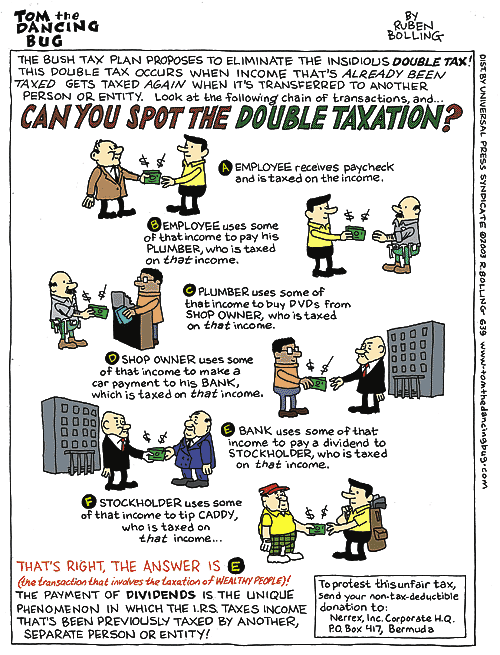
Furthermore, why is an inheritance tax needed? The income was taxed upon earning, and any growth in that sum was taxed via capital gains. To then take even more via 'inheritance tax' is just government thievery.
This "multiple taxation" nonsense is nonsense. Everything is taxed multiple times: I pay income tax on my salary. I spend my salary buying apples, and I pay sales tax on this. From the money I paid for apples, the store pays the cashier's salary, and part of this goes to income tax. The cashier spends their salary on software from my employer, and part of this goes to the state as sales tax. My employer uses the cashier's money to pay my salary, and I pay income tax again to close the circle.
Money flows in circles, and every single transaction in the chain is subject to taxation. Picking out one particular tax on one particular kind of transaction -- surprisingly, one that only affects rich people -- and claiming that it is somehow extraordinary is intellectually dishonest. Abolishing the inheritance tax is what would create an exception from the general rule.
As for:
> why is an inheritance tax needed?
As a method of redistribution from the very rich to the very poor, to create a more level playing field for everyone. (I'm not claiming that there is a particularly level playing field anywhere, especially not in the US. But abolishing inheritance taxes would certainly not make it more level.)
>As a method of redistribution from the very rich to the very poor, to create a more level playing field for everyone.
That's a nice theory, but the absolute top don't pay inheritance taxes as their wealth is tied up in huge complex financial instruments that they can transfer avoiding taxation. The goal is to make sure that doctor making $300k/year never breaks out of the middle/upper-middle class cage. The super-wealthy have many schemes to prevent the lowers from ascending to their level, this is just one of them.
That is not true. The capital gains have not been taxed and won't be taxed on death. It is a giant tax free gift upon death.
If your parent dies and they had bought a house for $100,00 and now it is worth $1,100,000. So a capital gain of $1,000,000. If they had sold the house they would have had to pay capital gains on the house, minus an exemption amount ($250,000 for single and $500,000 for married).
But you as the beneficiary get to take that house and immediately sell and pay $0 in capital gains on it. So that tax is actually forgiven on death.
They have been taxed. Real estate each year is taxed on assessed value; stock market gains unless left in a single security indefinitely are taxed on the gain and placed into another security.
To then suggest the money that has been taxed at fair and accepted rates along the way, should now be taxed a large amount bc another family member has it at 20-60% seems out of bound.
The reason this thinking feels ok, is because it applies to a minority of those in society who have accumulated (which is not me - but I'm arguing the counter-point). Imagine if your house was taxed 60-80% upon purchase or sale (same concept).
Earn a living is taxed. Groceries and clothing are taxed (in my state at least). Homes are taxed. Investing your hard earned savings back into our economy is taxed.
Getting a large sum of money from your extremely wealthy parents is also taxed.
Why is the last of these things less deserving of being taxed than the ones before it? If anything, it should be the other way around.
Taxes occur on business transactions (eg: groceries, clothing) which have a high tax (say 8%) since the transactions are smaller and monetary value of the tax is low.
Taxes on assets (real estate, stock capital gains) tend to be lower percentage value bc the asset price is high, thus the monetary value of the tax is high.
Inheritance tax seems to be a high tax on large assets, when no transaction occurs - just a transfer of ownership. If we did use that transfer to parallel a real estate transfer - then the value of tax should be a small percentage.
As engineers, this is actually a very easy problem to solve multi-generationally individually for us. It is a resource constraint algorithm.
I believe the "habit" should be modified. Educate to begin saving small sums from ages 15-23. More from 24-30. Lot more as career progresses. Savings over 50 years for individuals, then pass a part on to their kids so it can compound another 70 years. Do that a few generations, and the compounding IS big.
My take away is any family, from anywhere, can become wealthy in their future lineage. Which is an amazing thought. If you are reading this, your family can! THAT is amazing - mainly bc this game has been around for thousands of years, and only a subsection act on it.
The purpose of the inheritance tax is to prevent any competition for the truly elite. Wouldn't want the middle/upper-middle classes from actually achieving financial independence over 3-4 generations and checking out of the system would you?
Inheritance is a transfer of wealth, also known as income. Why should the people receiving that income get it tax free just because it came from a family member or close friend?
> Inheritance is a transfer of wealth, also known as income. Why should the people receiving that income get it tax free just because it came from a family member or close friend?
Good point. The government also taxes the monetary value of any goods transferred. After all, if I were to grant my car to my children upon my passing, that is income and ought to be taxed.
But let's continue even more. Whenever my mother-in-law provides childcare, the government should tax me for the money I would have spent on daycare. After all, that's giving me something with clear monetary value. Or when I visit my friend for a free dinner, I should have to pay tax on that too.
>Good point. The government also taxes the monetary value of any goods transferred. After all, if I were to grant my car to my children upon my passing, that is income and ought to be taxed.
If you win a car on a game show, you are taxed on that just like you would be if you won money.
>But let's continue even more. Whenever my mother-in-law provides childcare, the government should tax me for the money I would have spent on daycare. After all, that's giving me something with clear monetary value. Or when I visit my friend for a free dinner, I should have to pay tax on that too.
They are providing a service and not wealth or income. We don't directly tax the reception of services. However you can make an argument that this is the equivalent of providing a service at a pay of $0. I'm not sure if it applies nationally, but I know many states make exceptions for the minimum wage when working with direct family members. We don't tax people on money they were saved from spending or the excess value they receive by underpaying their employees.
> Whenever my mother-in-law provides childcare, the government should tax me for the money I would have spent on daycare.
Rich people tend to have mothers-in-law who are well off and don't need to work for money, so have time for unpaid childcare and other care work. Poor people tend to have mothers-in-law who are less well off, need to work for money, and don't have as much time for unpaid care work. Poor people might therefore have to spend money on childcare that richer people get for free. This is one of the ways in which wealth begets wealth, and an example for how expensive it can be to be poor. This is an important societal issue, and it is good of you to call attention to it.
Child care should be free (as in, financed by progressive taxes) everywhere, for everyone. The government should absolutely tax those who have more disposable income more than those who have less. It's simpler and more economically efficient (you are in favor of economic efficiency, I can tell) to do this based on general income and wealth levels than by sending inspectors everywhere to determine whether they "would" have spent money on daycare.
Nah... seeing my own poor family having my grandparents watch us, I think poor people are as or more likely to use family as childcare than the rich. And I think it would be immoral to tax them on these 'wealth transfers'.
The government doesn't want it's citizens to horde money. A ton of money sitting in the bank or in assets doesn't really do anyone any good. An inheritance tax pushes the rich into using their money - instead of leaving your kids cash and assets, you leave your kids a company or something similar. They can either continue to own the company and get paid for it or sell it and get taxed on it. Regardless, a company that provides jobs is a much more interesting prospect to the gov't than just rich people with assets.