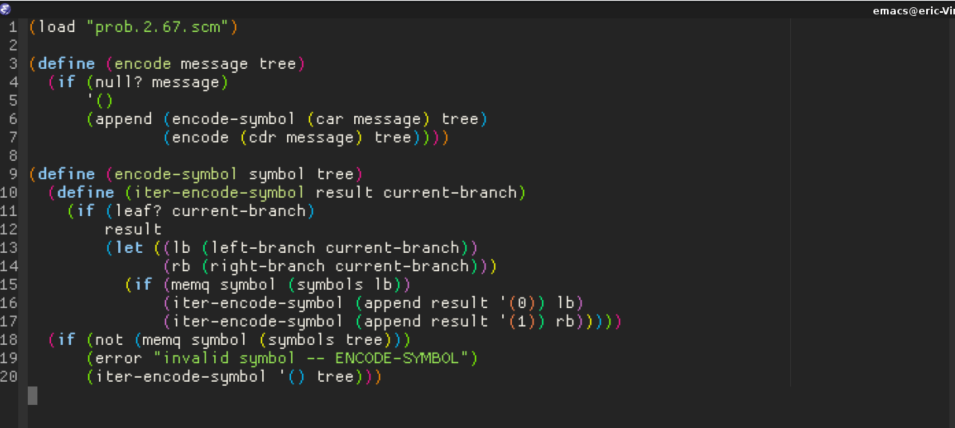
That's neat, better than ruby in that regard. Still hate the () syntax especially when you have a bunch of nested functions, I bet you get used to it though
Most use an IDE such as Emacs (paredit-mode and rainbow-parens) that handles automatic paren matching for you, so it's really a non-issue after the first week. The editor takes care of indentation, matching (so you don't have any dangling parens ever), and optionally colors matching pairs in the same color so you can easily tell what level they're at.
After a few years, I turned off rainbow-parens-mode indefinitely. I realized that I no longer see parentheses and instead I see the structure and order, or in the case of badly-written code - chaos and anarchy.
It is sad that the usual first reaction of people seeing Lisp code is distaste. I myself wasted years of my life because of that. I had many opportunities to learn Lisp, but I dismissed them multiple times until I tried Clojurescript. Stupid me.
> especially when you have a bunch of nested functions
In non-lispy langs like JS, deeply nested statements could lead to callback hell or pyramid of doom, making the code harder to read, understand, and debug.
In Lisps, nested expressions are common and idiomatic due to the Lisp's code-as-data philosophy. In Lisps, code is composed of expressions that can be composed together, with each expression potentially being an evaluation of other sub-expressions. This doesn't lead to a pyramid of doom, since the emphasis often is on data transformation rather than orchestration of side effects. Nested expressions allow you to build complex behaviors from simpler ones in a very direct and composable manner, thereby making code concise and easy to reason about.
Deeply nested statements in Javascript often hurt readability and maintainability, while nested expressions e.g., in Clojure typically enhance them due to their emphasis on code/data composition and transformation. It is a difference of chaotic complexity versus structured and intended composition.