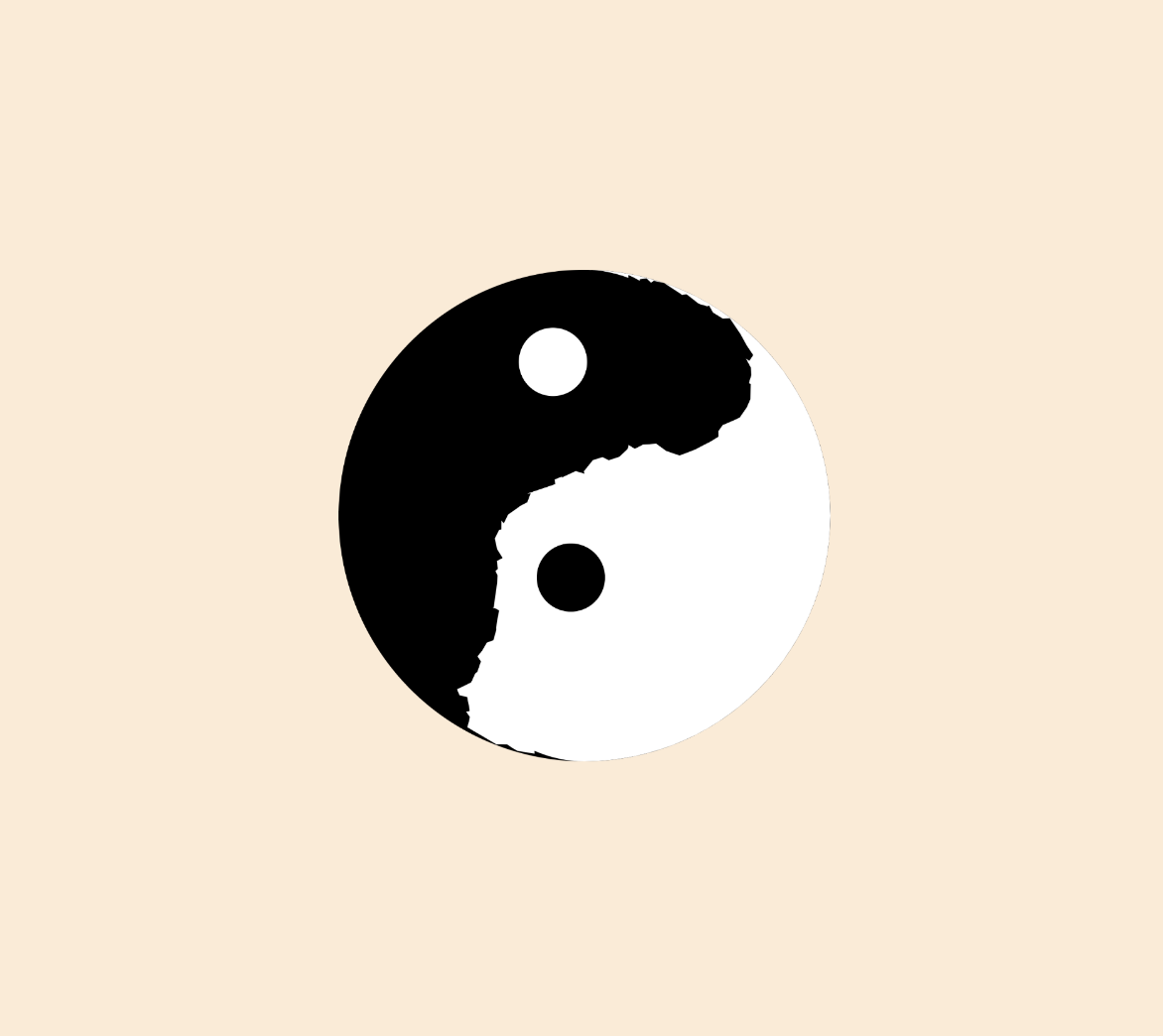
Not to alarm anyone, but when I ran this, the black ball eventually joined the dark side and the whole thing ended up black. I’m sure this doesn’t mean anything for the greater universe.
I think it's just a tunneling bug that happens when the point that make up the wall get messed up a enough. Almost never happens anymore in the v2[1] that I added. This one also allows you to see these points.
black-white here doesn't mean bad-good. they just mean opposites, different aspects of things. I think wikipedia does a pretty good job explaining it: https://en.wikipedia.org/wiki/Yin_and_yang
9. (philosophy) "female" principle; yin in yin-yang
10. in intaglio
11. treacherous; deceitful; cheating
12. (dialectal) to deceive; to trick; to trap
13. (Chinese phonetics, of a syllable) open; not having a consonant coda
14. (Cantonese) bangs; fringe
15. genitalia (of humans)
16. a surname
The one (American) person I know who has 陰 as a surname reports that Chinese people are often shocked at her surname upon meeting her. I think it might be a bit like having the surname Death in English (https://www.ancestry.com/last-name-meaning/death?geo-lang=en...).
That is to say, black kind of does mean "bad" here, in the popular conception anyway. Taoism and Buddhism promote a worldview that sees birth and death, creation and destruction, as neither good nor bad, simply inseparable parts of a larger whole. But most everyday people try to avoid darkness, death, destruction, cloudiness, gloominess, shadows, ghosts, treachery, traps, and so on, most of the time. It's more that Taoism teaches that this attempt is foolish.
Not all the senses are unpopular; plenty of people like human genitalia, the Moon, and intaglio, and the shady side of a river can be nicer when it's hot out.
Yes true :D, I kind of just want to blame gpt-5 mini for it and that's one of the bad things about the bad coding, I immediately loose part of the sense of ownership and responsibility. I don't feel like I made it, I just managed it.
Now to be honest I saw this bug, but I decided to just release it anyways because I also already had the v2 in the works which incidentally already had this issue fixed.
I think next level would be custom shapes, custom starting areas, more colors, ability to change physics (add gravity?), and user interacting (being able to help a fellow struggling entity -a ball in this case-, when it gets worse).
Someone put this into an AI super duper thinking max edition, sprinkle some MCP on top and see what happens lol
Thanks :D I did really want to know what kind of shape it would tend towards over time.
Running 100x for some moments, the white part got pincer maneuvered by the black and I ended up with the whole circle becoming black. Don't know what to think of that lol
The cool thing about this is that it's self-balancing - if either side gets larger than the other due to random chance, the ball in that side will have more space to bounce in, and therefore bounce less often, slowing its growth. Meanwhile, the ball in the smaller side will bounce more often in its smaller space, making up the ground.
That's not a stable equilibrium if the hits have a large enough effect with respect to the movement of the balls. The internal circle will create disturbances against both sides of the inner circle, but the outer ball will have to travel a longer distance to move from one side to the other to counter them.
Now the question remains, are there stableish equilibria that are 50/50? Splitting it into two half-circles sounds like an equilibrium at first glance, but I'm not convinced it is, as only a tiny bit of random luck seems to make it become a "horseshoe" pattern instead.
(That assumes that the simulation is randomized of course, which doesn't seem to be the case for the one in the link posted here.)
It seems there is a parallel with physics: two pressurized chambers with equal pressure and a membrane separating them. The odd thing here is that there is only one molecule in each of them.
I was cheering on the black circle's tunneling project when they both got caught in a rapid-fire spiral and the black one glitched through to the other side.
Same, if one of them punches through in one place, that hole shapes the angle of the bounces and reinforces itself and the other side fills in around the hole.
I made a game on this principle many years ago. Two players with turn left,turn right, thrust and fire. You can only exist in your own space, shooting at the walls dug holes of your colour.
You had a bunch of critters scattered around the map trying to get home and you had to make paths for them while stopping your opponent from getting their critters home.
People are responding to you saying that it doesn't retain the yin-yang shape, but I've been watching for a while on 64x speed, and the yin-yang shape is one it repeatedly returns to.
I'm not even a dimwitted individual with an advanced degree in hyperbolic topology, but I can see what's happening intuitively. When one of the balls makes an indent large enough, that indent focusses the bounce from the circular edge which reinforces the indent further. This leads to a semi-stable shape where one of the balls is bouncing around a horseshoe and the other in a tunnel. However, if one side of the horseshoe becomes pinched small enough that ball is less likely to enter, that side of get eliminated, and you have a yin-yang.
More simply, the round edge seems to encourage tunnelling, and any asymmetry in the tunnelling is yin-yang-ish.
It doesn't. It quickly just becomes a random curve after a few minutes at normal speed if you leave it open.
For obvious reasons it tends to stay half white half black (if one half gets smaller its ball will bounce faster) but the shape and its orientation varies randomly.
Off the top of my head, there is no mechanism for tension, so it would basically approach a random curve with equal white and black areas over time, but in addition there is the point reassignment function which acts as a kind of low pass filter so you get something that looks like a sinusoid?
I think it’s just random chance. I haven’t run any simulations or anything, but I suspect the YY curve is no more stable than any simple 50-50 split. I bet over large timespans the YY curve straightens out just from entropy.
Shouldn't each circle be pulling in its own color instead of pushing the other one out? Right now it looks like they're expanding the opposing color, when you'd think they'd be rooting for themselves.
Sometimes I see the 'border' move slightly where a ball hasn't hit it. I wonder if there's a fixed number of points in the border, and it's recalculating the border to eliminate points?
Cool! It would benefit from better physics though, maybe supersampling the position in time especially when moving fast. Each ball can't push to its edge fully, for instance.
I’m really keen to see what this looks like after significant time but I’m not going to leave it open on my phone for ages just to find out haha. Clever idea!
It'd be interesting to see how the visuals change when you're viewing the path, rather than a filled area.
Not seen one of these tables with two balls in... You'd probably need quite a lot of height to offset the linear sliders so didn't collide with each other.
Cool now I'm not going to get anything done. Thanks OP. PLEASE add a speed control so I can speed it up to it's logical conclusion and move on with my day.
An edge point's probability of being hit should be proportional to the length of every path leading to that edge point. An area closer to many short black paths and many long white paths will show black expansion (and vice-versa). So I suspect that any variation of the central line from a straight bisection of the circle should get hammered out over time.
To me it's working backwards though. i.e. the black ball is creating more whitespace and visa versa. It's not immediately evident to me why that would be the case.



https://francisduvivier.github.io/eternal-struggle-with-spee...
Code: https://github.com/francisduvivier/eternal-struggle-with-spe...